What Is Cyclocartography? Timing on Your Astrocartography Map
You’ve found your astrocartography lines: maybe a Venus line through a city you’ve always wanted to visit, or a Saturn line through a town where things were hard. Those lines are fixed. They’re drawn from the moment and location of your birth, and just like the birth chart itself, they don’t move.
A line does nothing by itself. It indicates what is happening in your relocated chart: a second imprint laid over your natal imprint, like a permanent transit. The two are always read together.
But the planets didn’t stop moving when you were born, and that movement can be drawn on the same map. That’s cyclocartography: timing on the map. I abbreviate astrocartography as ACG and cyclocartography as CCG, so if you see CCG in my notes, it means the timing version of the map. It comes out of Jim Lewis’s system, the same one his astrocartography belongs to.
Transits and progressions
I use two kinds of timing lines. Transit lines show where the planets actually are now, set against your birth chart. Progressed lines come from your secondary progressions, a day-for-a-year technique: the chart for the day after you were born describes your first year, the next day your second, and so on. Either one can be projected onto the map as a second set of lines over your birth lines. And those lines move.
They move at the speed of the planet. Mars is quick. Pluto, which takes 248 years to circle the Sun, barely inches along. When Lionel Messi played his first official game for Barcelona, on 16 October 2004, he had transiting Pluto on his Midheaven in that part of the map. By 2007, at his peak fame, it was right on top of him, and it didn’t move off until 2011. The outer planets can stay with a person for years.
Progressed lines are slow too. Your progressed Sun moves about one degree a year and changes sign about every 30 years, while the progressed Moon moves faster. Progressed lines drift east over your lifetime, unless the planet was retrograde when you were born, in which case they drift west.
For transits I mostly use the outer planets. When I know the exact date of an event, I’ll also turn on Jupiter, the faster planets and the Lot of Fortune, which I’ve seen set off events over and over. I find timing lines strongest within about 250 miles (about 400 km), and for a heavy planet like Pluto, or for the Sun or Moon, I’ll consider them out to about 400 miles (about 650 km).
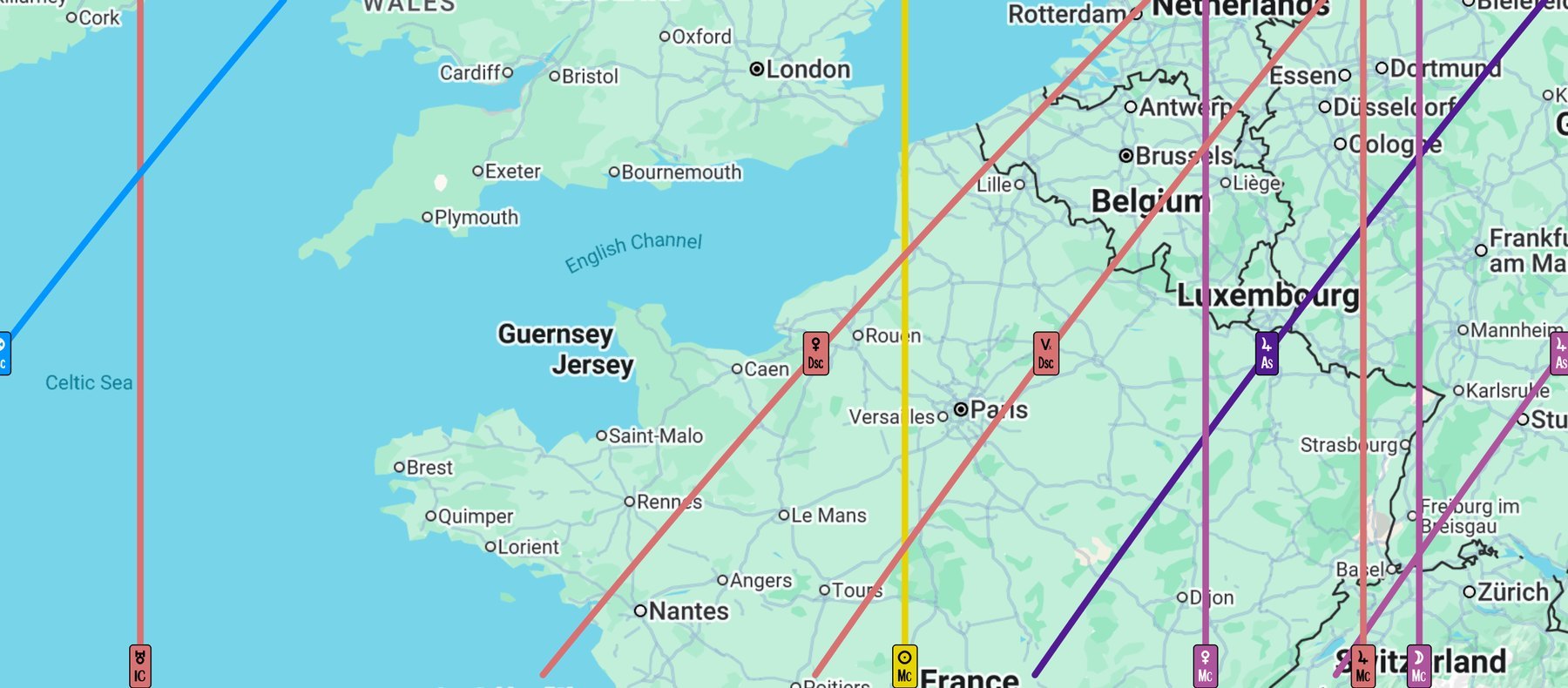
Same map, different year
I’m on my progressed Mars MC right now while writing, and I can definitely feel the difference from my cozy Venus line back in France. I came here deliberately to focus on a complete overhaul of my website, building tools, developing my upcoming Astromapping Fundamentals for Astrologers 5-week course, and other goal-oriented things.
Midheaven and Ascendant lines can often bring actual events rather than just a vibe, and that goes for progressed lines too.
Vivien Leigh’s London map shows timing landing on a single night. On 15 May 1935 she went on stage in London and became famous overnight; Laurence Olivier read the reviews and came to see her. That night she had transiting Uranus on her IC and transiting Venus on her Descendant, both in range of London. Uranus on the IC shakes up home life, and she went on to leave her husband for Olivier. The birth lines through London were the same as they’d always been. The timing lines over them weren’t.
I go through this map step by step in a video and article, Uranus on the IC: Vivien Leigh, Russell Brand and One Transit Over London, and set it beside Russell Brand’s map. He had the same slow transit come into range of London, with a very different result.
When a place changes
When a client tells me about something that happened in a place, and I don’t really see it on their map, I turn on their timing before I go looking for anything subtler. Almost always I’ll go, “Oh, that was a transit,” or “That was a progressed line.” If you can’t find it in the birth lines, you’ll almost always find it in the timing.
That works going forward, too. A slow transit sitting over where you live will pass eventually, and the map shows roughly when. A good line combined with a good transit can be really powerful, and I’ve sent clients to a place during a Venus transit with stellar results. Digital nomads consult me six months ahead to find where the most support will be, rather than where a really difficult transit is waiting.
Looking back can matter just as much. People have real breakthroughs when they see the timing behind a past event, good or hard, because it shows there was some order to it.
Why a free map can’t show you this
A free map shows your birth lines. Cyclocartography needs professional software that specializes in astrocartography. I use Zeus, and I teach it in a recorded Zeus tutorial. Even with it, the layers stack up: the birth chart, the relocated chart, the birth lines, the parans and other extras, and then timing on top. As if there weren’t enough to look at already. There’s too much data to synthesize at a glance, which is why I prepare every reading ahead of time.
In a reading, the timing is one of the things I check for the places we talk about. There’s rarely time to go through all of it in one session, so I usually show a brief preview at the end, and we can go into it properly in a follow-up.
To see timing lines move across a map a month at a time, watch the video.
If you’re still getting to know your birth lines, start with How to Read Your Astrocartography Map.