There’s No Best City on Earth for You: The Astrocartography App Lied
Astrocartography app ads promise your “best city on earth.” I tested them: wrong lines, bad info, a 3-minute trial, and subscriptions that are nearly impossible to cancel. Here’s how to spot the bait.
I recently had a reading with a client who was planning a move. They’d found the city in one of those astrocartography apps, which said it was their “best city on earth.” When I opened up the real map, it was actually probably a bottom-five city for this person. They would have had a very hard time settling there, among other difficulties.
This isn’t the first client to come to me this way and unfortunately it’s becoming more and more common.
I’ve now had many other clients bring me an app’s results after the fact. Some have already made major decisions based on an app’s advice that turned out to be completely bogus. One client’s app results said their “best city on earth” was a certain place in Europe that turned out to be on a Pluto line crossing with a Mars line. This person had multiple difficult aspects to Pluto in their chart. It was actually probably their worst city on earth.
This post is for anyone who has seen these trickster ads made by app-developing tech bros who don’t seem to care in the least about astrocartography, or your wellbeing.
Here’s the unsimplified truth: Every astrocartography line has its positive side and its challenging side, and the details of how that plays out depends on all the rest of your unique chart placements. Plus, each line will activate different parts of your own chart, various areas of life. There is no such thing as one generic “best city on earth” for anyone.
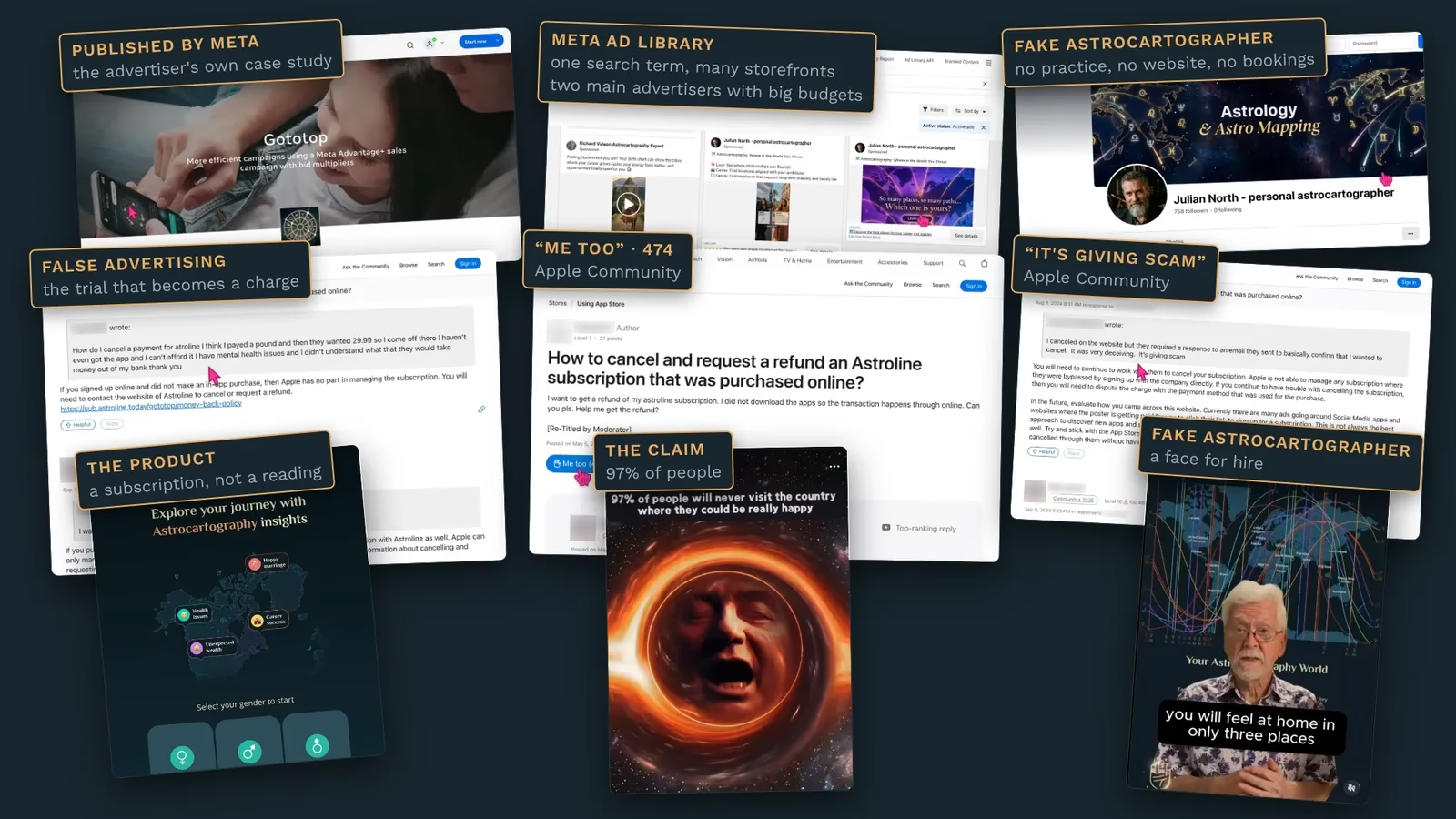
The prolific astrocartography app ads
A presenter talks to the camera over a world map striped with lines. The caption: “you will feel at home in only three places.” Another sponsored post says “97% of people will never visit the country where they could be really happy.” Others promise you’ll only be happy in three places in the world.
These ads run prolifically on Facebook and Instagram, and Meta’s Ad Library, which is public, shows who pays for them. Search “astrocartography” and you get one search term, many storefronts, and two main advertisers: app developers with enormous budgets.
What they sell is a seemingly randomly-generated verdict…three cities out of the *whole planet*. That is NOT how the technique works.
I tested them
I didn’t want these spammy apps and AI-generated websites on my real devices. So I ran them on an old iPhone 8 I don’t use anymore and an old laptop, in case they infected something. For the test I used a public birth, actress Vivien Leigh’s (5 November 1913, Darjeeling), because anyone can check it and because I know her map well.
The (likely AI) generated information had absolutely nothing to do with her map. In some apps, no map was calculated at all, it just spat out cities, and the interpretations were wildly inaccurate.
The astrocartographers in the ads aren’t real
The ads are fronted by faces. One is “Julian North, personal astrocartographer,” whose Facebook page had around 758 followers when it was checked in October 2026. I did a deep dive, searched for a website, a way to book him, a practice, and found…nothing. The page has ads and zero content behind them. “Richard Valeon, Astrocartography Expert,” got the same searches with the same result.
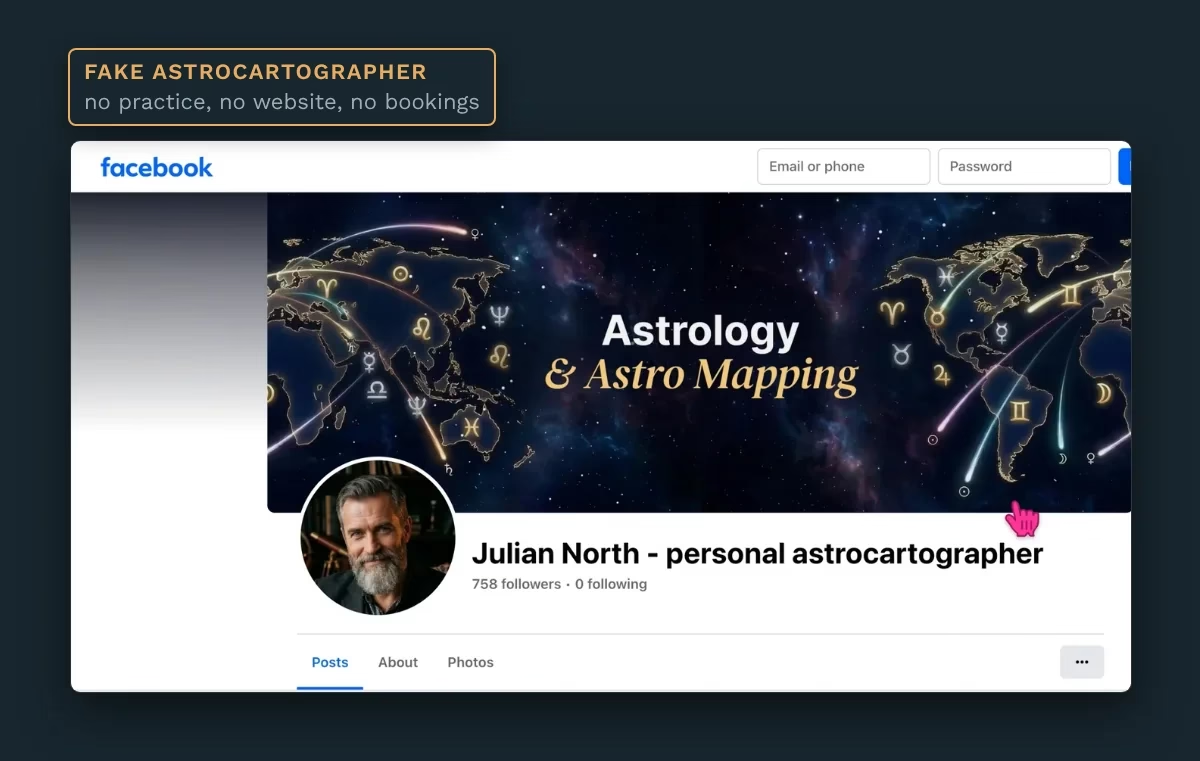
It’s fairly obvious that “Julian North” is AI-generated (and pretty creepy looking). And white-haired Richard Valeon in the “three places” ad looks more like someone paid to read a script, the kind of user-generated-content work people get hired for. Neither is an astrocartographer anyone can book an appointment with and their only presence is within the ads and sponsored pages. Astroline’s own website says “Every reading … is written by real advisors with real experience,” and lists its advisors by first name. Neither face appears there.
In Meta’s Ad Library, the Julian North page advertises two storefronts: hint.app and sub.astroline.today. Hint is made by a different company, Ruby Labs. One face, two companies’ checkouts.
The product is the subscription
On 27 April 2024, Spain’s consumer organization OCU published a complaint filed under “Suscripción no autorizada,” unauthorized subscription. A €1 three-minute Astroline trial, paid through Apple Pay, became an automatic €29.99 subscription; emails went unanswered. The customer got a refund only after filing publicly.
On Apple’s own forum, a thread titled “How to cancel and request a refund an Astroline subscription that was purchased online?” has been open since 5 May 2024. As of 28 October 2026, 475 people had clicked “me too.” One wrote, on 7 September 2024: “I think I payed a pound and then they wanted 29.99… I can’t afford it.”
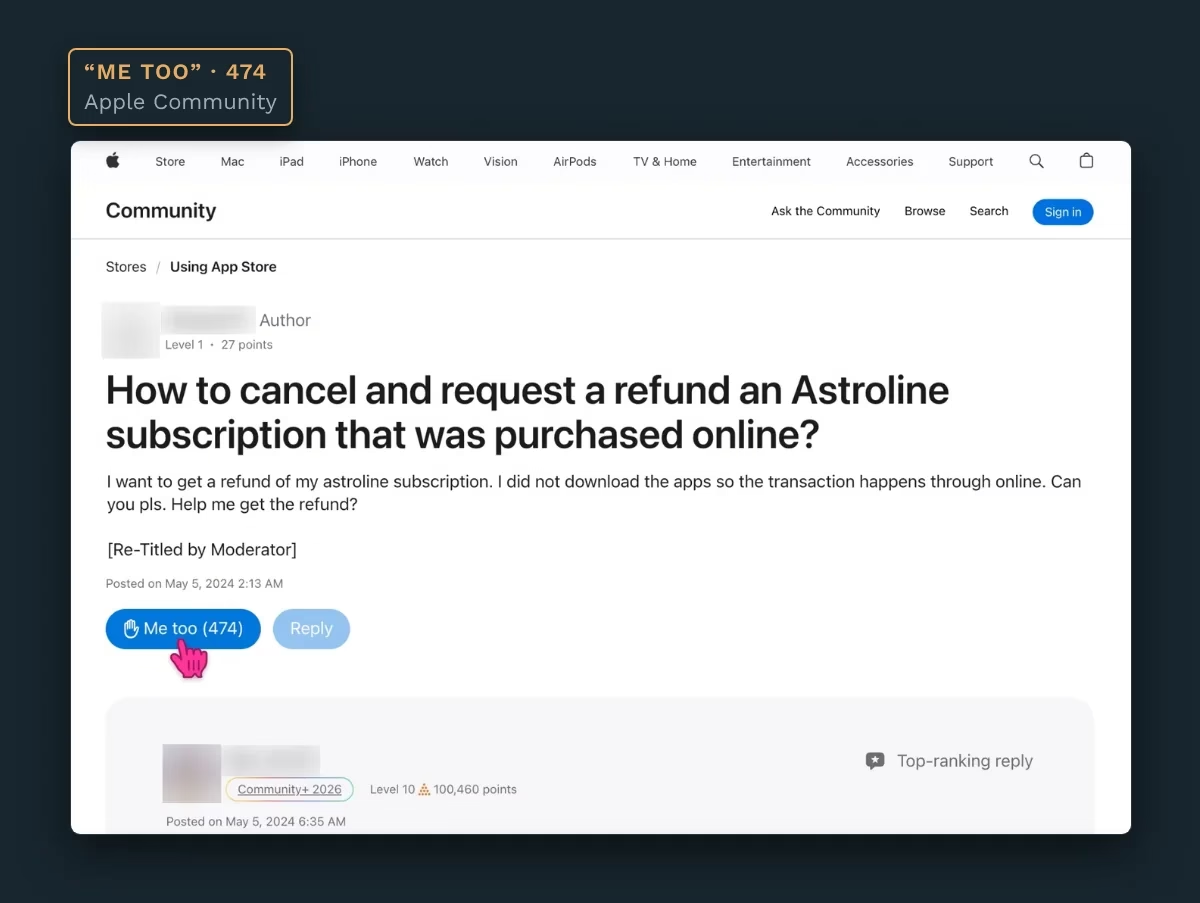
The top-ranked answer, from a veteran community member on 9 August 2024, doesn’t explain how to get a refund through Apple. It says: “evaluate how you came across this website. Currently there are many ads going around Social Media apps and websites where the poster is getting paid for you to click their link to sign up for a subscription… you will need to dispute the charge.”
If you signed up through a web page rather than the App Store, that’s why Apple can’t refund it, and why the advice is to dispute the charge with your bank. The cancellation link quoted in that thread is: sub.astroline.today/gototop/money-back-policy.
How to tell a real reading from app bait
Astrocartography readings aren’t cheap, but they’re much less expensive than moving to an unfortunate location based on a sloppy app. Here are some tips for finding a reputable reading, or check out my free guide on how to read your astrocartography map:
- A named human, with a booking page and a professional footprint you can find online outside the ad.
- Check your own map on a reputable free calculator (like astro.com) before anyone charges you.
- Keep in mind that the lines don’t do anything; they indicate the relocated chart. A line sold as a verdict is a sales pitch and a real astrocartographer heavily considers your relocated charts against your natal chart.
- Nobody can sell you a “best city.” A reading weighs your goals and what you want from a place against what your chart shows there.
- A trial that asks for your card is a subscription. Find out what it becomes, and when.
- A 1.5-star app with a five-star ad budget.
Astromapping is older than its brand
Astrocartography isn’t a trick an app developer came up with recently; astromapping as old as astrology itself. I trace it back to omen geography around 1800 BCE in The Ancient Art of Astromapping.